When to Follow Up on a Sales Proposal: The Signal-Based Answer
When to Follow Up on a Sales Proposal
The Signal-Based Answer
Following up on a sales proposal is awkward because the timing is never obvious.
Follow up too early and you feel pushy. Follow up too late and the prospect may have already moved on. Wait too long and your proposal becomes just another forgotten PDF in their inbox.
Most salespeople guess.
They follow up after three days, five business days, or whenever anxiety finally wins.
The better approach is to follow up based on buyer behavior.
If a prospect opens your proposal, returns to it, spends time on pricing, or shares it with another stakeholder, that is a signal.
And signals beat guesses.
This guide explains when to follow up on a sales proposal, what engagement signals to watch, and what to say based on how the prospect interacts with your document.
The Simple Answer
The best time to follow up on a sales proposal is when the prospect shows engagement.
That could mean:
- They opened the proposal
- They returned to it later
- They spent time on the pricing page
- They viewed the scope or timeline section
- They shared it with another stakeholder
- They never opened it after a few days
Each of those situations deserves a different follow-up.
A prospect who opens your proposal three times should not get the same email as someone who never opened it.
That is the core idea.
Instead of asking:
“Has it been enough days?”
Ask:
“What has the prospect done since I sent the proposal?”
That one shift makes your follow-up more relevant.
Why Proposal Follow-Up Timing Matters
Fast follow-up matters because buyer attention fades quickly.
A Harvard Business Review article on online sales leads found that companies that contacted potential customers within an hour were nearly seven times as likely to qualify the lead compared with companies that waited even one additional hour.
You can read the article here:
The Short Life of Online Sales Leads — Harvard Business Review
HubSpot also shares sales follow-up examples and guidance showing that timing, relevance, and personalization all matter when trying to continue a sales conversation.
You can read HubSpot’s guide here:
HubSpot Sales Follow-Up Email Guide
The exact timing number is less important than the principle:
When a buyer is actively engaged, the window is short.
That does not mean you should call every prospect the second they open your proposal.
It means you should stop treating every prospect the same.
A prospect who opens your proposal, reviews pricing, and comes back later is showing more intent than someone who has not opened the document at all.
Your follow-up should reflect that.
The 3 Wrong Ways People Follow Up
Before getting into the right timing, it helps to understand what usually goes wrong.
Most bad follow-ups fail for one of three reasons.
1. Following Up on a Fixed Schedule
This is the classic approach:
“I’ll follow up on Tuesday.”
The problem is that Tuesday might be too early, too late, or completely irrelevant.
Your calendar does not tell you whether the prospect is interested.
If the prospect opened your proposal Monday afternoon and reviewed it with their team, Tuesday morning might be perfect.
But if they never opened it, Tuesday morning is just a guess.
Fixed schedules are easy to manage, but they ignore buyer behavior.
2. Waiting a Random Number of Days
Many people follow up after three or five business days because it feels polite.
But a fixed delay does not always match the deal.
If the prospect opened your proposal five minutes after you sent it and reviewed pricing twice, waiting five days may be a missed opportunity.
On the other hand, if they have not opened it at all, your follow-up should probably be about making sure they received it, not asking whether they are ready to move forward.
The issue is not that three days or five days is always wrong.
The issue is that the number is random unless it is connected to buyer activity.
3. Following Up Only When You Panic
This happens when you wait too long, hear nothing, and finally send a vague email like:
“Just checking in to see if you had a chance to review.”
The problem is that this email does not add much value.
It reminds the prospect that you are waiting, but it does not help them make a decision.
A better follow-up should give the prospect a useful next step.
For example:
- Offer to clarify pricing
- Offer to walk through the scope
- Send a shorter summary
- Ask if another stakeholder should be included
- Share a relevant case study
- Suggest a short decision call
The goal is not to “check in.”
The goal is to help the prospect move forward.
The Better Approach: Follow Up Based on Engagement Signals
The right time to follow up is when the prospect shows intent.
That intent usually appears through engagement signals.
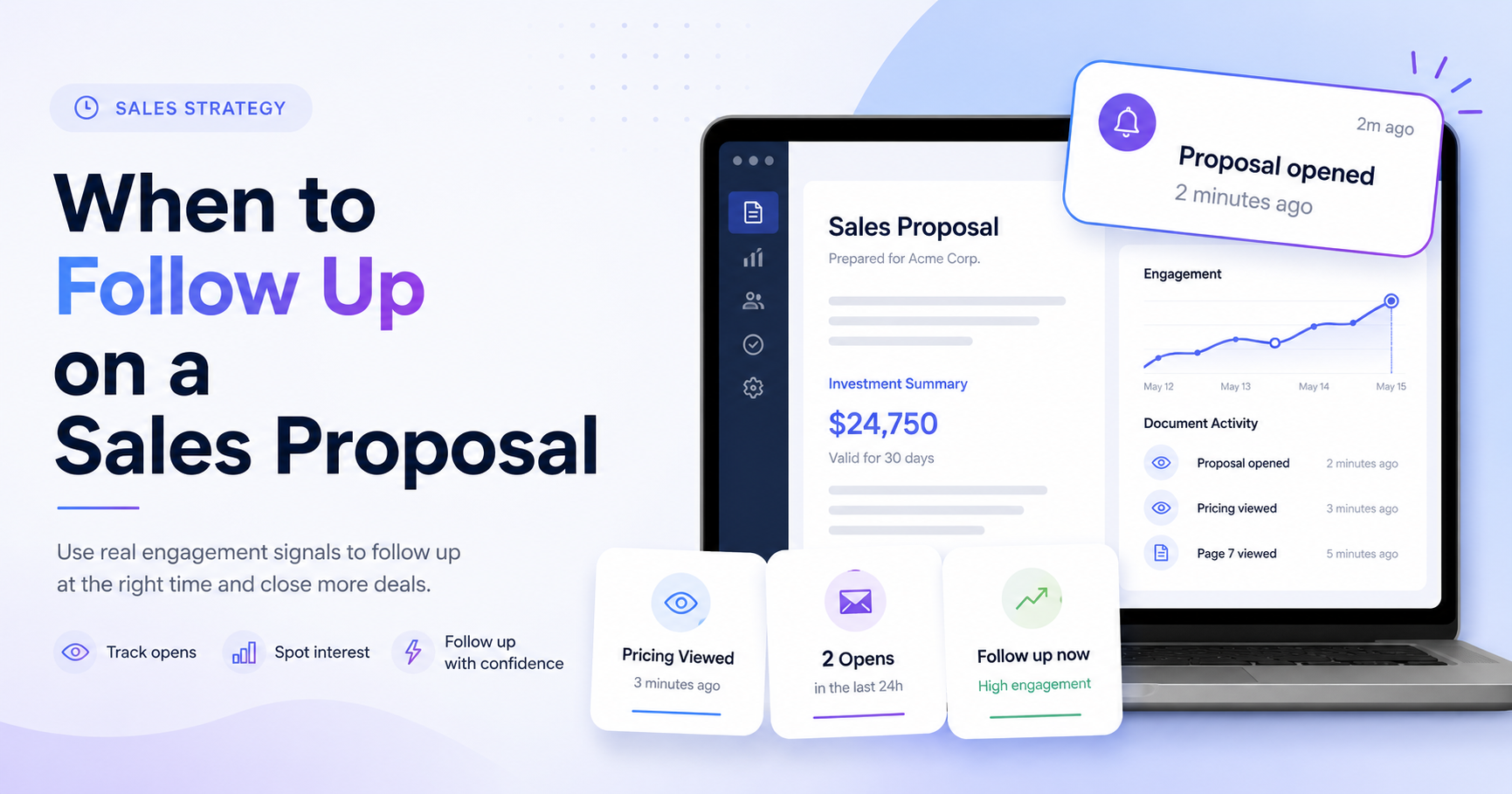
If you are using a document tracking tool like Tracklytics, you can see what happens after the proposal is sent.
That may include:
- When the proposal was opened
- How many times it was opened
- Which pages were viewed
- How long the viewer spent
- Whether pricing was reviewed
- Whether another viewer opened it
- Whether the prospect returned later
These signals give you a better reason to follow up than:
“I sent this a few days ago.”
They help you send a message that matches the prospect’s actual behavior.
Proposal Follow-Up Timing by Signal
Here is a practical way to decide when to follow up.
| Proposal Activity | What It Might Mean | When to Follow Up | Best Follow-Up Angle |
|---|---|---|---|
| First open | They are reviewing the proposal | Same day or next business day | Offer to answer questions |
| Multiple opens | They may be actively evaluating | Same day | Suggest a quick walkthrough |
| Time spent on pricing | Pricing, budget, or scope may matter | Same day | Offer to clarify pricing or adjust scope |
| Time spent on case studies | They may need proof | Same day or next day | Share a relevant example |
| New viewer appears | The proposal may have been forwarded | Same day or next day | Ask if others should join the conversation |
| No opens after a few days | They may have missed it | After 2–3 business days | Confirm they received the link |
| Opened once, then no activity | Interest may be low or unclear | After 2–4 business days | Send a short summary or next step |
| Opened before a meeting | They are preparing | Before the call | Tailor the agenda around viewed sections |
This is not about being creepy.
It is about being useful.
The prospect already has your proposal. Your job is to make the next step easier.
What to Do If They Open the Proposal Once
A first open means the prospect has at least started reviewing the proposal.
You do not need to immediately jump in with a hard close.
A simple, helpful follow-up works best.
Example Follow-Up
Hey Sarah, I wanted to check in while the proposal is still fresh. Happy to answer any questions or walk through the scope if helpful.
This works because it is natural.
It does not say:
“I saw you opened the proposal.”
It simply follows up while the proposal is likely still on their mind.
What to Do If They Open the Proposal Multiple Times
Multiple opens can be a stronger signal.
It may mean the prospect is comparing options, reviewing details, or coming back before making a decision.
In this case, your follow-up can be slightly more direct.
Example Follow-Up
Hey Sarah, I wanted to see if it would be helpful to do a quick 10-minute walkthrough of the proposal. Happy to clarify the scope, timeline, or next steps.
This gives the prospect an easy next step without being pushy.
What to Do If They Spend Time on Pricing
If the prospect spends time on the pricing page, pricing may be part of the decision.
That does not automatically mean the price is too high.
They could be comparing packages, checking budget fit, reviewing scope, or discussing it with another decision-maker.
Your follow-up should create space for that conversation.
Example Follow-Up
Hey Sarah, happy to walk through the pricing options if helpful. There are a few ways we can adjust the scope depending on what matters most to your team.
This is better than asking:
“Any thoughts?”
It gives the prospect a useful reason to respond.
What to Do If They Spend Time on the Scope or Timeline
If someone spends time on the scope, deliverables, or timeline section, they may be checking feasibility.
They may want to know:
- What is included
- How long the work will take
- What happens first
- What they need to provide
- Whether the timeline fits their goals
Your follow-up should reduce uncertainty.
Example Follow-Up
Hey Sarah, I’m happy to walk through the scope and timeline if useful. We can also adjust the rollout depending on what your team wants to prioritize first.
This makes the follow-up practical instead of generic.
What to Do If They Review Case Studies or Testimonials
If a prospect spends time on case studies, testimonials, or results, they may be looking for proof.
That is your opportunity to reinforce trust.
Example Follow-Up
Hey Sarah, I can also send over a similar example from a client with a comparable workflow if that would be helpful.
This works because it connects the follow-up to evidence.
Instead of pushing for a decision, you are helping them feel more confident.
What to Do If a New Viewer Opens the Proposal
A new viewer can be an important signal.
It may mean the proposal was forwarded to another stakeholder, manager, partner, or decision-maker.
That does not guarantee the deal is moving forward, but it suggests the document may be circulating internally.
Your follow-up should make it easy to include others.
Example Follow-Up
Would it be helpful to include anyone else from your team in the next conversation?
This is simple, professional, and not too aggressive.
It also helps you avoid being stuck with only one contact when the decision involves multiple people.
What to Do If They Never Open the Proposal
If the prospect has not opened the proposal after a few days, your follow-up should not assume they reviewed it.
Do not ask:
“What did you think of the proposal?”
They may not have seen it.
Instead, confirm delivery and make it easy for them to engage.
Example Follow-Up
Hey Sarah, just wanted to make sure the proposal link came through properly. I can resend it or send a short summary if that is easier.
This is a much better follow-up because it matches the situation.
If they never opened the proposal, the first job is to get them back to the document.
What to Do If They Opened Once and Went Quiet
Sometimes a prospect opens the proposal once and then disappears.
This can mean a few things:
- They skimmed it and lost interest
- They got busy
- They need internal approval
- They were confused
- They are comparing other options
- The proposal did not create enough urgency
Your follow-up should lower the effort required to respond.
Example Follow-Up
Hey Sarah, I know things get busy. I’m happy to send a quick summary of the main scope, pricing, and next steps if that would be easier than going through the full proposal.
This gives them an easier path back into the conversation.
What to Avoid in Proposal Follow-Ups
A good proposal follow-up should be useful, specific, and easy to respond to.
Avoid these common mistakes.
Avoid Saying “Just Checking In”
“Just checking in” is common, but it is weak.
It does not give the prospect a reason to respond.
Replace it with something specific:
“Happy to clarify the pricing options if helpful.”
Or:
“Would it be useful to walk through the scope together?”
Avoid Mentioning Every Tracking Detail
You do not need to say:
“I saw you spent three minutes and 42 seconds on page four.”
That sounds uncomfortable.
Use the insight to guide your message, but keep the wording natural.
Avoid Following Up With No Next Step
A vague follow-up creates more work for the prospect.
A better follow-up should suggest a clear next step:
- A 10-minute call
- A pricing walkthrough
- A scope clarification
- A shorter summary
- A stakeholder meeting
Avoid Treating Every Prospect the Same
Different behavior should lead to different follow-up.
Someone who reviewed pricing needs a different message than someone who never opened the proposal.
That is why engagement-based follow-up works better than calendar-based follow-up.
Signal-Based Follow-Up vs Calendar-Based Follow-Up
Calendar-based follow-up asks:
“How many days has it been?”
Signal-based follow-up asks:
“What has the prospect done?”
That difference matters.
| Follow-Up Style | How It Works | Problem | Better Alternative |
|---|---|---|---|
| Calendar-based | Follow up after a fixed number of days | Ignores buyer activity | Use engagement signals |
| Panic-based | Follow up after silence becomes stressful | Usually sounds generic | Create a useful next step |
| Generic | Send the same message to everyone | Low relevance | Match the message to the behavior |
| Signal-based | Follow up based on opens, views, and activity | Requires tracking | More relevant and timely |
The best sales teams do not follow up randomly.
They follow up when there is a reason.
How Tracklytics Helps With Proposal Follow-Up
Tracklytics helps you follow up based on behavior instead of guesswork.
You upload your proposal, send the Tracklytics link, and get notified when your prospect opens it.
From there, you can see engagement signals such as:
- Opens
- Repeat views
- Page activity
- Time spent
- Pricing interest
- New viewer activity
- Heatmap-style engagement
That gives you a better reason to follow up than:
“Just checking in.”
For example, if a prospect opens your proposal twice and spends time on pricing, you can follow up with a message about pricing and scope.
If they never open it, you can resend the link or send a shorter summary.
If another viewer appears, you can ask whether other stakeholders should be included.
This is how Tracklytics helps turn document engagement into better follow-up timing.
Read the full guide to proposal tracking:
How to Know When a Prospect Opens Your Proposal
See current plans:
Start tracking your next proposal:
A Simple Proposal Follow-Up Framework
Here is a simple framework you can use.
Step 1: Send the Proposal With a Trackable Link
Do not send the proposal as a static attachment if you need follow-up context.
Use a trackable link so you can understand whether the prospect opened it and what they reviewed.
Step 2: Watch for Engagement Signals
Look for signs like:
- Opens
- Reopens
- Pricing views
- Long time spent
- New viewers
- No opens
These signals help you decide what kind of follow-up makes sense.
Step 3: Match the Follow-Up to the Signal
Do not send the same message every time.
If they reviewed pricing, talk about pricing.
If they reviewed scope, talk about scope.
If they did not open it, confirm they received it.
If a new viewer appeared, ask whether others should join.
Step 4: Keep the Message Natural
The prospect does not need to know every detail you saw.
Use the data to be helpful, not invasive.
A good follow-up should feel like support, not surveillance.
Step 5: Make the Next Step Easy
End with a simple next step.
Examples:
- “Want me to send a shorter summary?”
- “Would a 10-minute walkthrough help?”
- “Should we include anyone else from your team?”
- “Do you want me to clarify the pricing options?”
- “Would it help if I adjusted the scope into two package options?”
Make it easy for the prospect to reply.
Final Answer: When Should You Follow Up?
You should follow up when the prospect shows engagement.
If they open the proposal, follow up while it is fresh.
If they spend time on pricing, offer to clarify pricing or scope.
If they return later, suggest a quick walkthrough.
If another viewer appears, ask if more stakeholders should be included.
If they never open it after a few business days, confirm they received the link.
The best proposal follow-up is not based on guessing.
It is based on timing, context, and buyer behavior.
That is how you move from:
“Just checking in.”
To:
“Here is something useful based on where you are in the decision.”
About Tracklytics
Tracklytics helps sales teams, founders, agencies, consultants, and marketers follow up based on real document engagement instead of guessing.
When someone opens a sales proposal, reviews pricing, returns later, or shares the document with another stakeholder, Tracklytics helps turn that activity into useful follow-up context.
For proposal follow-up timing, Tracklytics is designed to help teams move from calendar-based follow-up to signal-based follow-up.
Instead of sending a proposal and waiting in the dark, Tracklytics helps you see what happened after the link was opened.
FAQ
When Should I Follow Up After Sending a Sales Proposal?
The best time to follow up is when the prospect shows engagement.
That could be after they open the proposal, return to it, spend time on pricing, review the scope, or share it with another stakeholder.
How Long Should I Wait Before Following Up on a Proposal?
If there is no engagement, a short follow-up after 2–3 business days is reasonable.
If there is engagement, follow up sooner while the proposal is fresh in the prospect’s mind.
What Should I Say in a Proposal Follow-Up Email?
A good proposal follow-up should be specific and useful.
Instead of saying “just checking in,” offer to answer questions, clarify pricing, walk through the scope, or send a shorter summary.
Should I Follow Up Immediately After a Prospect Opens My Proposal?
You can follow up the same day, but keep the message natural.
Do not say you saw every action they took. Use the engagement signal to send a helpful message at the right time.
What If the Prospect Never Opens the Proposal?
If they never open it after a few business days, confirm that the link came through properly.
You can also offer to resend the proposal or send a shorter summary.
What If the Prospect Keeps Opening the Proposal?
Multiple opens may suggest active evaluation.
That is a good time to offer a quick walkthrough, clarify pricing, or ask if there are any questions before the next step.
What If Someone Else Opens the Proposal?
A new viewer may mean the proposal was forwarded internally.
A good follow-up is:
“Would it be helpful to include anyone else from your team in the next conversation?”
How Does Tracklytics Help With Proposal Follow-Up?
Tracklytics shows when prospects open your proposal and how they engage with it.
You can see signals like opens, repeat views, page activity, pricing interest, and new viewer activity. That gives you better timing and context for follow-up.
Is Proposal Tracking Useful for Agencies and Consultants?
Yes.
Agencies and consultants can use proposal tracking to see whether clients opened proposals, reviewed pricing, read scopes of work, or returned to reports before a follow-up call.
Is Signal-Based Follow-Up Better Than Calendar-Based Follow-Up?
Yes, because signal-based follow-up uses actual buyer activity.
Calendar-based follow-up only tells you how many days have passed. Signal-based follow-up tells you whether the prospect is engaging.
Stop guessing. Start knowing.
Track when prospects open your proposals, see which pages they read, and follow up at exactly the right moment.
Try Tracklytics free →