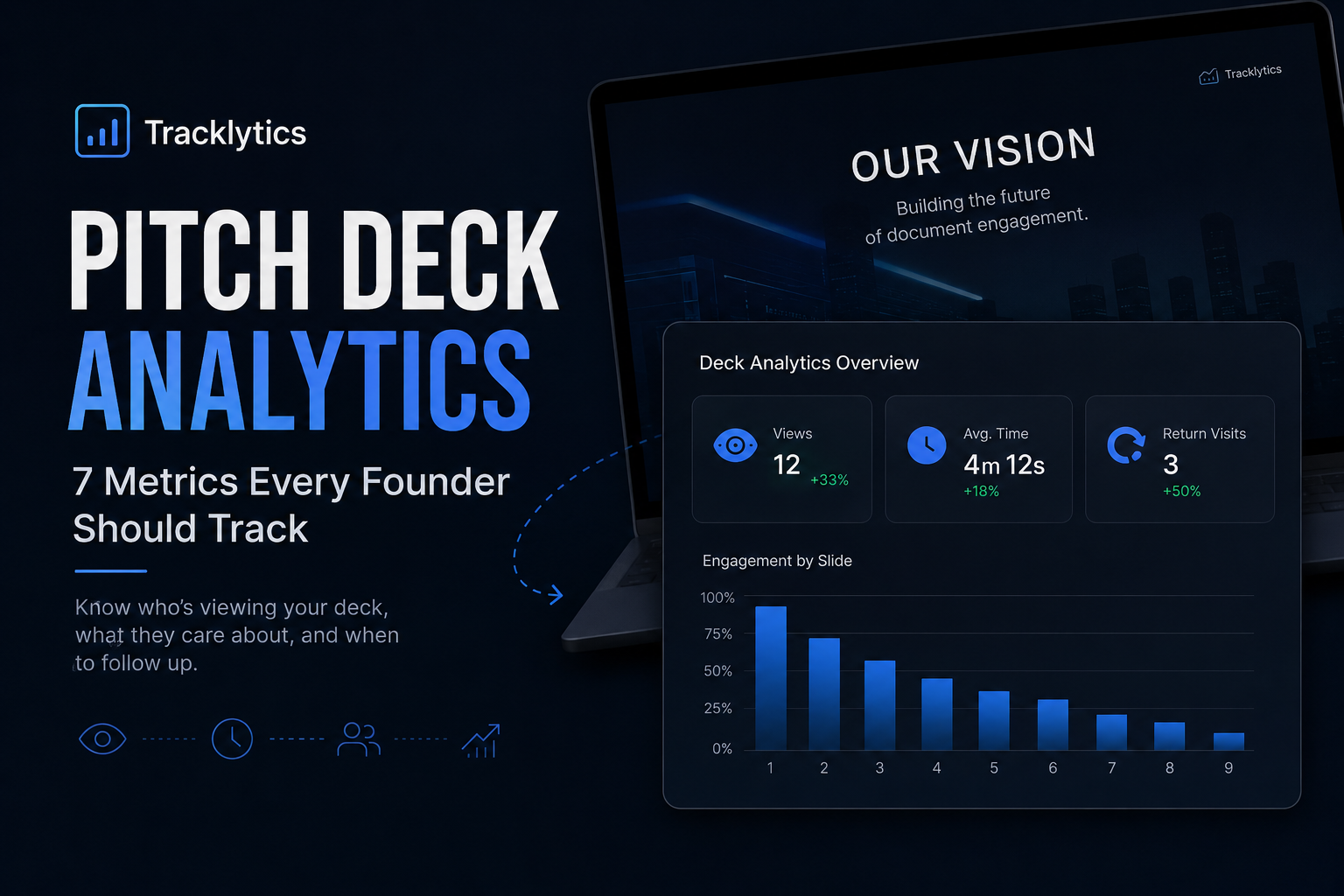
Pitch Deck Analytics: 7 Metrics Every Founder Should Track
Pitch Deck Analytics: 7 Metrics Every Founder Should Track
You sent your pitch deck to 20 investors.
Now what?
Without pitch deck analytics, you are left guessing.
You do not know who opened it, who ignored it, whether anyone forwarded it to a partner, or which slides actually got attention.
That is a problem because investor interest is often quiet before it becomes obvious.
A partner may review your deck twice before replying. An associate may forward it internally. Someone may spend four minutes on your traction slide and ten seconds on everything else.
Pitch deck analytics helps you see those signals before the email reply arrives.
It does not guarantee that an investor will write a check. But it helps you understand who is engaging, which slides are working, and where to focus your follow-up.
Here are seven pitch deck analytics metrics every founder should track.
What Is Pitch Deck Analytics?
Pitch deck analytics is the process of tracking how investors interact with your pitch deck after you send it.
Instead of attaching a static PDF and hoping for a reply, founders can send a trackable deck link and measure engagement.
Pitch deck analytics can show signals such as:
- Whether an investor opened the deck
- How many times they opened it
- Which slides they spent time on
- Where they dropped off
- Whether they returned later
- Whether the deck was viewed by more than one person
- Which investors appear most engaged
This matters because fundraising is not just about sending more decks.
It is about understanding which investors are actually paying attention.
A strong fundraising process is built on focus. If one investor opened your deck once for 20 seconds and another returned three times, viewed the traction slide, and had a second viewer join, those are not the same level of engagement.
Pitch deck analytics helps you prioritize your time.
Why Founders Should Track Pitch Deck Engagement
Fundraising already has enough uncertainty.
You usually do not know what is happening after you send your deck.
Did the investor open it?
Did they skim it?
Did they forward it?
Did they stop at the problem slide?
Did they spend time on traction?
Did they come back later?
Without analytics, all of that is invisible.
Pitch deck analytics gives founders better context for three things:
- Investor follow-up
- Pitch deck improvement
- Fundraising prioritization
It helps you stop treating every investor the same.
If an investor never opens your deck, your next step might be a short bump or a better intro.
If they open it multiple times, your next step might be a useful follow-up.
If they spend time on traction, your next call should probably be ready to go deeper on growth, retention, revenue, usage, or proof.
If they drop off early, your opening slides may need work.
That is the value of tracking.
It turns quiet investor behavior into useful fundraising signals.
Quick Summary: The 7 Pitch Deck Metrics to Track
| Metric | What It Tells You | Why It Matters |
|---|---|---|
| Open rate | How many investors opened your deck | Shows whether your outreach is working |
| Time per slide | Which slides received attention | Shows what investors care about |
| Drop-off slide | Where investors stopped viewing | Shows where the deck may lose momentum |
| Return visits | Whether investors came back later | Shows possible continued interest |
| Unique viewers | Whether the deck may have been shared | Shows possible internal circulation |
| Funding ask slide engagement | Whether investors reviewed the raise details | Helps you prepare for funding questions |
| Total session count | How often the deck was viewed overall | Helps separate passive interest from active review |
Now let’s break each one down.
1. Open Rate
Open rate tells you what percentage of investors actually opened your deck.
If you sent your pitch deck to 20 investors and only three opened it, the issue may not be the deck.
The issue may be your:
- Subject line
- Intro email
- Investor targeting
- Warm referral quality
- Timing
- Sender credibility
- Email length
- Call-to-action
Open rate helps separate outreach problems from deck problems.
That matters because founders often make the wrong fix.
If investors are not opening the deck, rewriting every slide may not solve the real issue.
You may need a sharper email, a better investor list, or a warmer intro.
What a Low Open Rate Might Mean
A low open rate could mean:
- Your email subject line is weak
- Your intro is too long
- The investor is not a fit
- The investor is busy
- The deck link was buried
- The outreach was too cold
- The message did not create urgency
What to Do If Open Rate Is Low
If your open rate is low, do not immediately rebuild the whole deck.
First, improve the outreach.
Try:
- A shorter email
- A clearer one-line company description
- A stronger reason for why this investor is a fit
- A more specific ask
- A warm intro when possible
- A cleaner subject line
For example, instead of writing a long intro, make the email simple:
“We are building Tracklytics, a document tracking platform that helps teams see who opens proposals, pitch decks, and PDFs. We are raising our seed round and I thought this could be relevant based on your work with B2B SaaS companies.”
Open rate tells you whether your email earned enough interest for the investor to click.
2. Time Per Slide
Time per slide shows which slides earned attention.
This is one of the most useful pitch deck analytics metrics because it helps you understand what investors actually spent time reviewing.
If investors spend the most time on traction, business model, or go-to-market, that tells you what they may care about.
If they skim the team slide or skip the ask slide, you may need to improve those sections.
Time per slide turns your pitch deck into feedback.
What Time Per Slide Can Show
For example:
- Long time on the market slide may mean investors are evaluating market size
- Long time on the traction slide may mean they are looking for proof
- Long time on the business model slide may mean they are checking how you make money
- Long time on the team slide may mean they are evaluating founder-market fit
- Short time on the problem slide may mean it is clear, or it may mean it is not compelling
- Short time on the ask slide may mean the raise details are unclear or not reviewed
The important thing is not to overinterpret one data point.
A single investor spending time on one slide does not prove exactly what they are thinking.
But if multiple investors spend time on the same slide, that pattern is worth paying attention to.
What to Do With This Metric
If investors spend time on a slide, prepare to talk about it.
If your traction slide gets the most attention, be ready to explain:
- Growth rate
- Retention
- Revenue
- Active users
- Pipeline
- Conversion
- Customer proof
- What changed recently
If your market slide gets the most attention, be ready to explain:
- Market size
- Customer segment
- Why now
- Why this market is growing
- Why your entry point is specific enough
Time per slide helps you prepare better investor conversations.
3. Drop-Off Slide
Drop-off shows where readers stopped.
If most investors drop off on slide three or four, your deck may be losing momentum early.
Maybe the problem is unclear.
Maybe the market slide is weak.
Maybe the opening takes too long.
Maybe the deck does not explain the company fast enough.
Maybe the value proposition is buried.
A strong deck should pull people forward.
The goal is not to force every investor to read every slide. The goal is to understand where attention breaks.
Common Drop-Off Problems
Here are common reasons investors may drop off:
- The first slide does not explain what the company does
- The problem slide feels too generic
- The market slide is too broad
- The product slide is confusing
- The traction slide appears too late
- The deck has too much text
- The story does not build momentum
- The investor is simply not a fit
Drop-off data helps you find friction.
What to Do If Investors Drop Off Early
If investors drop off early, improve the first few slides.
Your opening should quickly answer:
- What do you do?
- Who is it for?
- Why does it matter?
- Why now?
- What traction or proof do you have?
- Why are you the right founder or team?
A common mistake is making investors wait too long for the point.
Your deck should not start with five slides of background before explaining the business.
Get to the core idea quickly.
4. Return Visits
A return visit is one of the strongest engagement signals.
If an investor opens your deck again later that day or within 48 hours, they may be thinking about it, preparing questions, comparing it with other opportunities, or discussing it with someone else.
Not every return visit means a yes.
But it is usually warmer than a single short skim.
Return visits help you prioritize follow-up.
If one investor opened your deck once for 30 seconds and another came back three times, those are not equal leads.
What Return Visits Might Mean
A return visit could mean:
- The investor is reviewing before a call
- They are discussing it internally
- They are checking a specific slide again
- They are comparing your company with another startup
- They are preparing questions
- They are still curious
Again, it is a signal, not proof.
But it is a useful signal.
How to Follow Up After a Return Visit
A good follow-up should be helpful, not creepy.
Do not say:
“I saw you opened the deck three times.”
Instead, say something natural:
“Happy to walk through the deck and answer any questions. The two areas investors usually ask about are our go-to-market motion and the next milestone after this round.”
This gives the investor a reason to respond without making the tracking feel uncomfortable.
5. Unique Viewers
Unique viewers help you see whether your deck may have been forwarded.
If you sent the deck to one investor and two or three viewers opened it, that may mean it was shared with a partner, associate, analyst, or someone else on the investment team.
That matters because fundraising decisions often involve more than one person.
A second viewer does not guarantee interest, but it can be a signal that the deck is moving beyond the first person.
Why Unique Viewers Matter
Unique viewers can help you understand:
- Whether your deck is being shared internally
- Whether more than one person is reviewing the opportunity
- Whether the investor may be discussing it with a partner
- Whether your follow-up should include more context
- Whether it may be time to suggest a meeting
What to Do If New Viewers Appear
If new viewers appear, keep your follow-up professional.
You could write:
“Would it be helpful to include anyone else from your team on a quick walkthrough?”
That is better than mentioning the exact viewer count.
The goal is to make the next step easy.
6. Funding Ask Slide Engagement
Your funding ask slide matters.
This is the slide where investors understand what you are raising, why you are raising it, and what the round unlocks.
Depending on your deck, this may include:
- Round size
- Use of funds
- Runway
- Hiring plan
- Milestones
- Revenue targets
- Product roadmap
- Go-to-market goals
If investors spend extra time on the ask, use of funds, traction, or business model slide, they may be evaluating whether the round makes sense.
This can help you prepare better follow-up answers.
Questions to Prepare
If investors spend time on the funding ask or use-of-funds slide, be ready to answer:
- Why are you raising this amount?
- How long will this capital last?
- What milestones will this round unlock?
- What hires are most important?
- What happens if you raise less?
- What happens if you raise more?
- What does success look like after this round?
- What traction do you need for the next round?
A clear funding ask builds confidence.
A vague funding ask creates hesitation.
What to Improve
If investors spend time on the ask slide but do not respond, review whether the slide clearly explains:
- The amount being raised
- The use of funds
- The next milestone
- The expected runway
- The reason this amount makes sense
You do not need to overload the slide.
But the logic should be clear.
7. Total Session Count
A single session may mean curiosity.
Multiple sessions can signal active evaluation.
Total session count shows how many viewing sessions happened across a deck.
If an investor opens your deck three times, reviews it from multiple sessions, or returns after a meeting, that is worth paying attention to.
Total session count helps you separate passive interest from active review.
What Session Count Can Show
A higher session count may mean:
- The investor is revisiting the deck
- The deck is being reviewed by more than one person
- The opportunity is still being evaluated
- The investor is preparing for a call
- The investor is comparing your startup with others
A low session count is not always bad.
Some investors may read once and respond quickly.
But when combined with time per slide, return visits, and unique viewers, session count becomes useful.
What Good Pitch Deck Engagement Looks Like
Good pitch deck engagement usually includes a few patterns.
For example:
- Multiple sessions
- Meaningful time on key slides
- A return visit within 48 hours
- Time spent on traction, business model, or go-to-market
- More than one viewer
- Activity before or after a meeting
An investor who spends eight minutes across your deck, returns the next day, and spends extra time on traction is probably warmer than someone who spends 45 seconds on the first three slides and never returns.
That does not mean the first investor will invest.
It means they are worth prioritizing.
Cold Engagement
Cold engagement usually looks like:
- No open
- One short session
- Early drop-off
- No return visit
- No additional viewers
- Very little time on key slides
Warm Engagement
Warm engagement usually looks like:
- Return visits
- Longer time on key slides
- Multiple sessions
- Additional viewers
- Activity around traction, business model, market, or funding ask
- Engagement after a follow-up or meeting
The goal is not to obsess over every click.
The goal is to spot patterns that help you make better fundraising decisions.
What to Do With Pitch Deck Analytics
Pitch deck analytics should change your follow-up.
Different investor behavior should lead to different follow-up messages.
If an Investor Never Opened the Deck
Send a short bump or try a different intro.
Example:
“Hey Alex, just wanted to make sure this did not get buried. Happy to send a shorter summary if easier.”
If an Investor Opened It Once and Dropped Off Early
Your email may have created enough curiosity, but the deck may not have held attention.
You may need to improve the opening slides.
Example:
“Hey Alex, sharing a quick summary in case helpful: we help teams track engagement on proposals, pitch decks, and PDFs so they know when to follow up.”
If an Investor Spent Time on Traction
Prepare a traction-focused follow-up.
Example:
“Happy to walk through the traction in more detail. The main things we are focused on now are activation, repeat usage, and converting early users into paid teams.”
If an Investor Returned Multiple Times
Follow up sooner with a useful next step.
Example:
“Hey Alex, happy to walk through the deck and answer questions. The two areas investors usually ask about are our go-to-market motion and the next milestone after this round.”
If Multiple Viewers Opened the Deck
Ask if others should be included.
Example:
“Would it be helpful to include anyone else from your team in a quick walkthrough?”
Pitch deck analytics helps you make follow-up more relevant.
What Pitch Deck Analytics Cannot Tell You
Pitch deck analytics is useful, but it has limits.
It cannot tell you exactly what an investor is thinking.
It cannot guarantee investor interest.
It cannot explain every reason someone spent time on a slide.
It cannot replace a strong fundraising process.
It cannot make a weak deck strong by itself.
Analytics should guide your follow-up, not replace your judgment.
A return visit is a signal.
A new viewer is a signal.
Time on a traction slide is a signal.
None of those signals guarantee a term sheet.
But they help you decide where to focus.
Fundraising Still Depends on the Fundamentals
Pitch deck tracking helps you understand engagement, but fundraising still depends on the fundamentals.
Investors still care about:
- Market size
- Founder-market fit
- Product clarity
- Traction
- Growth rate
- Business model
- Distribution
- Competition
- Timing
- Round size
- What the next milestone unlocks
YC’s seed fundraising guide is a useful resource for founders thinking through when to raise, how much to raise, and how to approach the seed fundraising process.
Read it here:
First Round also has a strong fundraising advice article based on lessons shared with founders raising follow-on capital.
Read it here:
First Round Fundraising Advice
Those resources help with fundraising strategy.
Pitch deck analytics helps with what happens after your deck is sent.
You need both.
How Tracklytics Helps Founders Track Pitch Decks
Tracklytics helps founders see what happens after they send a pitch deck.
Instead of sending a PDF attachment and waiting in the dark, founders can use Tracklytics to send a trackable link and understand investor engagement.
With Tracklytics, founders can track signals such as:
- Deck opens
- Return visits
- Time spent
- Page or slide activity
- Viewer identity
- New viewer activity
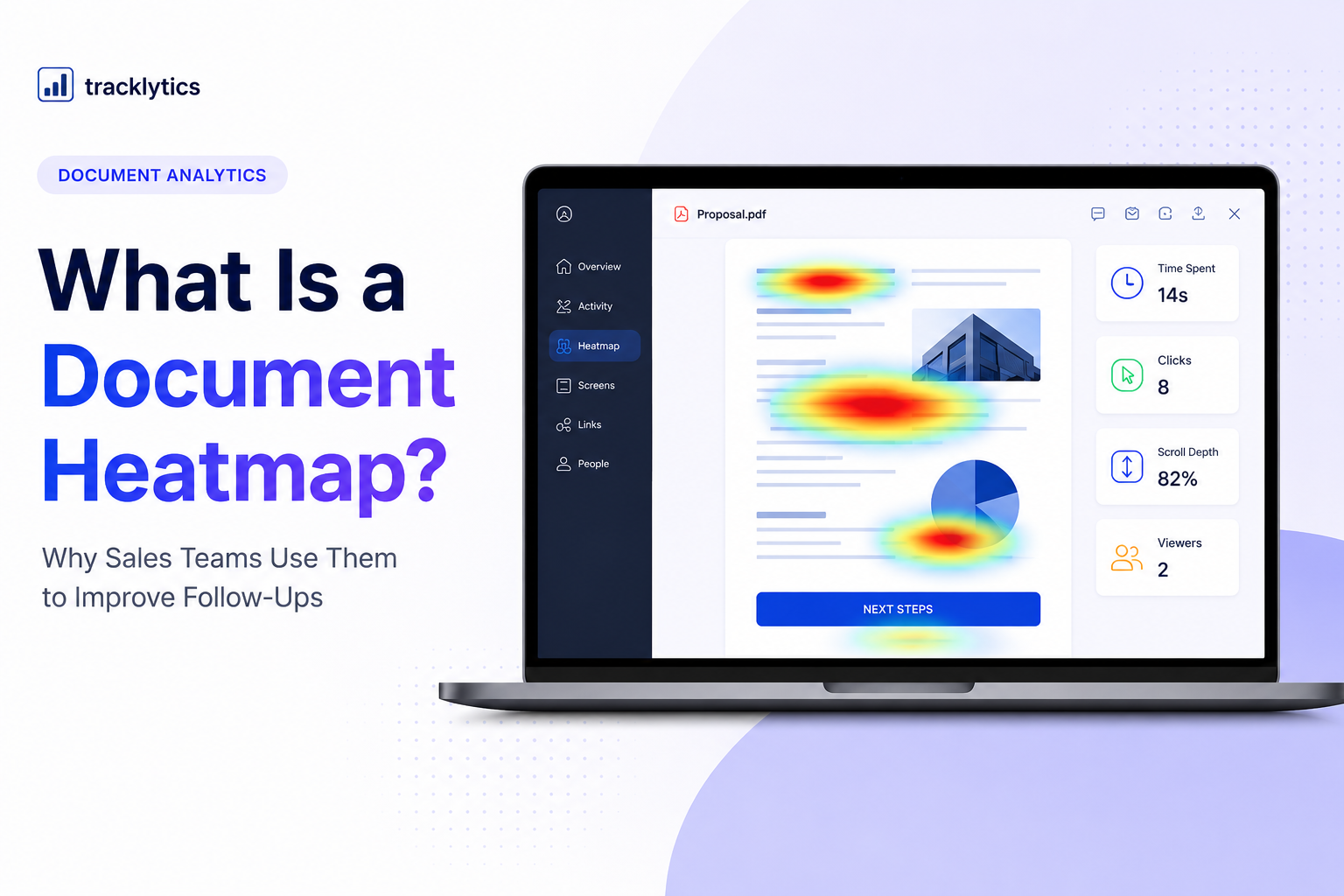
- Heatmap-style engagement
- Follow-up signals
This helps founders prioritize investor follow-up, improve the deck, and understand which opportunities may be warm.
For example:
- If an investor never opens the deck, send a short bump
- If they open it multiple times, follow up while interest is fresh
- If they spend time on traction, prepare traction details
- If a new viewer appears, ask if others should join the conversation
- If investors keep dropping off early, improve the opening slides
Tracklytics is built for founders, sales teams, agencies, consultants, and marketers who want to understand how people engage with important documents.
Start tracking your pitch deck:
See current plans:
Also read:
How to Know When a Prospect Opens Your Proposal
A Simple Pitch Deck Analytics Workflow for Founders
Here is a simple workflow you can use.
Step 1: Send a Trackable Deck Link
Instead of attaching the pitch deck as a regular PDF, upload it to a document tracking platform and send a trackable link.
This gives you visibility after the investor opens it.
Step 2: Track Opens and Return Visits
Start by watching who opens the deck and whether they return.
This helps you identify which investors are engaging.
Step 3: Review Time Per Slide
Look at which slides hold attention.
This helps you understand what investors care about and where the deck may need improvement.
Step 4: Watch for Drop-Off
Find where investors stop reading.
If many investors drop off early, improve the opening.
If they drop off before the ask, tighten the story.
Step 5: Prioritize Follow-Up
Use engagement signals to decide who deserves faster follow-up.
A founder’s time is limited. Use it where interest appears strongest.
Step 6: Improve the Deck Over Time
Do not treat the deck as finished forever.
Use analytics to improve slide order, clarity, proof, and pacing.
The best decks get sharper through feedback.
Pitch deck analytics gives you another source of feedback.
Final Recommendation
Every founder sending a pitch deck should track more than whether they got a reply.
The seven most useful pitch deck analytics metrics are:
- Open rate
- Time per slide
- Drop-off slide
- Return visits
- Unique viewers
- Funding ask slide engagement
- Total session count
Together, these metrics help you understand investor engagement, prioritize follow-up, and improve your deck.
The goal is not to monitor investors in a creepy way.
The goal is to stop fundraising blindly.
If someone opens your pitch deck, returns later, spends time on traction, or shares it with another viewer, that is useful context.
Use that context to follow up better.
About Tracklytics
Tracklytics helps founders track pitch deck engagement after they send their deck to investors.
Instead of guessing whether an investor opened the file, skimmed it, returned later, or forwarded it internally, founders can use Tracklytics to understand investor activity and prioritize follow-up.
For early-stage fundraising, Tracklytics is designed to give founders more visibility into quiet investor interest.
It helps founders move from guessing to signal-based follow-up.
FAQ
Can I Track Whether an Investor Opened My Pitch Deck?
Yes. With Tracklytics, founders can send a trackable pitch deck link and see when investors open it.
This helps founders understand whether the deck was actually viewed after being sent.
What Pitch Deck Analytics Matter Most?
The most useful pitch deck analytics metrics include open rate, time per slide, drop-off slide, return visits, unique viewers, funding ask slide engagement, and total session count.
Together, these metrics help founders understand investor engagement and improve follow-up.
Does a Return Visit Mean an Investor Is Interested?
A return visit is not a guarantee, but it is a warmer signal than a single short session.
Multiple sessions, longer viewing time, and additional viewers can suggest stronger engagement.
Should Founders Use Pitch Deck Tracking for Fundraising?
Yes. Pitch deck tracking can help founders prioritize investor follow-up, understand which slides get attention, and improve the deck over time.
It is especially useful when sending decks to multiple investors.
Is Pitch Deck Analytics the Same as Fundraising Success?
No. Pitch deck analytics can show engagement signals, but it does not guarantee investment.
Founders still need a strong company, strong story, clear traction, and a good fundraising process.
What Should I Do If Investors Do Not Open My Deck?
If investors do not open your deck, improve the outreach before rebuilding the deck.
Look at your subject line, intro, investor targeting, referral quality, and call-to-action.
What Should I Do If Investors Drop Off Early?
If investors drop off early, improve the first few slides.
Make sure the deck quickly explains what the company does, who it serves, why it matters, and what proof you have.
Can Pitch Deck Analytics Show If a Deck Was Forwarded?
Pitch deck analytics can sometimes show new or unique viewers, which may suggest the deck was forwarded or viewed by another stakeholder.
It does not always prove who forwarded it, but it can show that more than one viewer engaged with the deck.
How Does Tracklytics Help With Pitch Deck Analytics?
Tracklytics helps founders track deck opens, return visits, page activity, time spent, viewer engagement, and heatmap-style signals.
This gives founders better context for investor follow-up.
Can Pitch Deck Analytics Help Improve My Deck?
Yes. If investors consistently spend time on certain slides or drop off at the same point, you can use that information to improve your pitch deck structure, clarity, and pacing.
Stop guessing. Start knowing.
Track when prospects open your proposals, see which pages they read, and follow up at exactly the right moment.
Try Tracklytics free →